Disclaimer: This article is written keeping general readers in view and hence the usage of mathematical equations was strictly avoided. However, hyperlinks are provided for further reading.
Let us twitch with an interrogation
Let us twitch with an interrogation
“Why any inanimate solid, for
that occasion any material is capable of carrying load?”
The answer lies at the root of the whole study of
structures and the intelligentsia behind this is quite complex. If there is
anyone whom the credit shall be due is Sir Robert Hooke.
 |
| Sir Robert Hooke Courtesy: Wikipedia |
Hooke realized that materials can carry load by only
pushing back at it with an equal and opposite force. This is an implicit equivalence
of Newton’s Third Law.
To put this up rhetorically, a force just cannot get
away. In any circumstance force must be balanced and fought back by another
equal and opposite force at every point in the structure.
“Thou
shalt not go unreacted or unbalanced”
This statement holds firm for however small and simple or
however large and complex the structures may be. It is true not only for
cathedrals and floor but also for airplanes, balloons, furniture, lions,
tigers, cabbages and even earthworms.
As a consequence of Hooke’s pushing theory, He suggested
a law which we commonly recognize as Hooke’s Law or as I call it as Springiness
of Solids.
“The power of any
spring is in the same proportion with the tension (Hooke’s Time tension meant
what we should call an Extension) thereof: i.e. if one power stretch or bend it
in one space, two will bend it two, three will bend it three if there and so
forth and forward and this is rule of nature, upon which all manners of restitute
or springing
- Sir Robert Hooke
- Sir Robert Hooke
By 1676,
Hooke concluded that not only most solids resist weights or mechanical loads by
pushing back at them but also that:
- Every Solid changes its mechanical shape under the action of force.
- It is this change in shape which enables the solid to do the pushing back.
Thus
when we suspend a weight with a string, the string gets longer and just this
extension enables the string to pull upwards and carry the weight and prevent
it from falling. It is of great importance that it is perfectly normal for any
and every structure to change its physical dimensions in response to load.
Unless otherwise the deflection is too large for the purpose of the structure,
it is no way a fault but an vital characteristic for a structure to work.
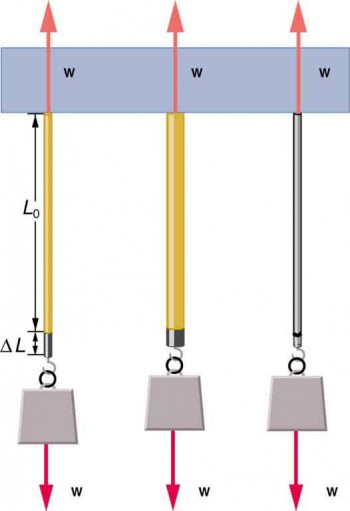 |
| Deformation of String under weight Courtesy: Lumen Learning |
Hooke
even postulated as a reasoning to his analogies of which most people often find
it difficult to follow is that when a structure deflects under load as we were
talking about earlier, the material with which it is made also gets stretched
to a very fine scale upto atomic bonds and molecules in perfectly uniform
proportions. As a matter of fact, masonry is more flexible than you think. If
you observe closely, almost all the old structures and buildings are bent
noticeably.
 |
| Defomed Stones of Khafrey Valley Temple Courtesy: Heidi Kontakanen, Flickr |
It
should also be kept in thought that Hooke knew nothing about chemical bonds,
and not very much about atoms or molecules either at his time. Yet, his
intuition and hypothesis that something of this sort was happening inside the
perfectly fine structure of material. He set out to determine, what might be
the macroscopic relation relationship between forces and deflection of solids.
His
intuitions towards the behavior of materials under the action of load
encouraged him to perform successive experiments on a variety of materials and
various geometric forms. He hung weights with these materials and found that
the load and deflection are directly proportionate.
Furthermore,
within the accuracy of Hooke’s experiments which was not so good in any means,
he found that most of the materials tested regained their original form after
the load was removed. As a matter of fact he could repeat these tests
indefinitely on and off without causing any permanent deformation. This
phenomena is termed as elastic. The term elastic might be used with rubber band
or undergarments usually but it is just as applicable to steel, stone, brick
and biological substances like wood, bone and tendon.
However,
some solids do not recover as mentioned and such solids are called plastics. In
fact, many materials which Hooke thought to be plastic in reality, when tested
with sufficiently accurate methods were plastic.
After
a series of private confrontations with the then researchers, Hooke published
his paper with famous statement “Ut
tension sic vis” (As the extension, so the force) which was widely known for
300 years as Hooke’s Law.
Although
Hooke’s contributions had been helpful for engineers but their practical form
applicability was rather limited. To be clear Hooke was the only person then
actually talking about deflections in structure as a whole under the action of
loads.
If we
pause and introspect for a moment, the deflection of a structure is based on
its geometric shape and material with which it is made. For instance a spring
made from steel is much easier to deflect under the action of force. But, a
girder made of steel is perfectly an opposite case. These examples can go on
and on. However, the important phenomena here to remember is that the stiffness
of a material varies greatly with form.
Although no material is truly rigid, materials like sapphire and diamond
are very stiff indeed. We need to sort this whole thing out and quantify the
aforementioned effects.
All of
this was a promising start for the structural science. However, it came to a
dead stop after Hooke’s death and was rather left out until reemerging after
120 years. The rivalry of Newton and Hooke could be kept in reference here.
Although, their rivalry is beyond the scope of this article, Newton was a
better constituted person to detest Hooke and loathe everything he stood for
including elasticity. It was a good fortune for newton to have lived for 25
years after Hooke died, he spent significant amount of time trying to denigrate
Hooke’s memory and importance of applied science. But, both Hooke’s and
Newton’s theories were proved correct later.
Although
Newton was a great mind, his enmity with practical approach of science and
inability to take criticism was a deterrent factor for his intellect. Thus the
situation throughout the 18th Century was that, while the manner the
in which the structures was broadly explained by Hooke, his work was not much
followed or exploited by researchers for a very longtime.
So
long as this, the practical and theoretical applicability of Theory of Elasticity
was limited. French Engineers despite knowing this, built structures basing on
this theory which quite often fell down. The English Engineers however, were
indifferent to use so called theories and built structures based on what may be
called rule of thumb practical methods. Those structures fell but not as quite
as often.
Inspired by JE Gordon's Structures
Inspired by JE Gordon's Structures
Good one!
ReplyDelete